

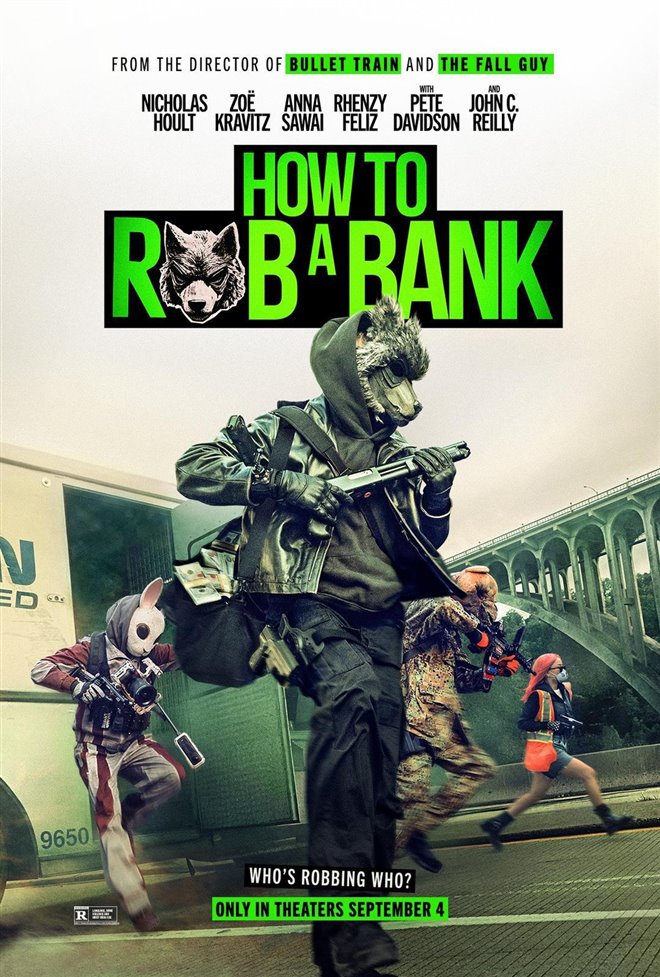
HOW TO ROB A BANK. Directed by David Leitch. Starring Nicholas Hoult, Zoe Kravitz, Anna Sawai, and Rhenzy Feliz. Rated M (Mature themes, violence, and coarse language). 122 min.
Review by Peter W Sheehan, Jesuit Media Australia
America is the country of origin, and the film is advertised as a dark action-comedy which is too simplistic a description. It is directed from a screenplay written by Mark Bianculli, and is English-speaking.
The film features a group of bank robbers who share their bank heists on social media, and the movie satirically explores criminal events involving them. The sharing of bank robberies with others causes heist activity to result in Police pursuing and tracking responsible robbers down. However, the police-chase is prior to any atonement of the robbery which has actually occurred.

The film makes for some unusual plot development. It intrigues with a twisted plot-line which allows the film to pursue and progress some thought-provoking themes. The twists in plot feature very unusual ways to rob banks, but much more is involved.
The plot twists are created by Ryan (Nicholas Hoult) who turns “bank robberies” into “lessons” on how to get away with criminal activity. The heists are actually intended to target corrupt banking systems that intentionally blur the dividing line between good and criminally-inspired evil. The film confronts and features illegality by inviting us to proactively consider what a robber has to do to be smart enough to evade detection. In this film, “smart” bank robbers share their heists, and the film is really one that satirises the dangers and risks of corporate control, while commenting in addition on the cost of pursuit. The sharing of heists obviously helps to evade detection, but much more is involved.
The film exposes viewers to an FBI agent, and a trained software engineer as it develops its plot-line and it invites us to view criminal events in a unique way. How much is Corporate greed, behind the robbery, actually involved, for instance? It takes a talented Director to explore how one separates good from evil and David Leitch rises to the challenge. The film is not really comic, but is genuinely watchable in unexpected ways, and Leitch’s direction is cleverly innovative. We are asked to consider how much corporate geed is widely integrated into business and social-political systems of thinking and planning, and it can be ambiguous as to who gains most from so-called major robberies. This is a movie that gets the viewer thinking afresh in stimulating and confronting ways.
Reviewed by Peter Sheehan, an Associate of Jesuit Media