


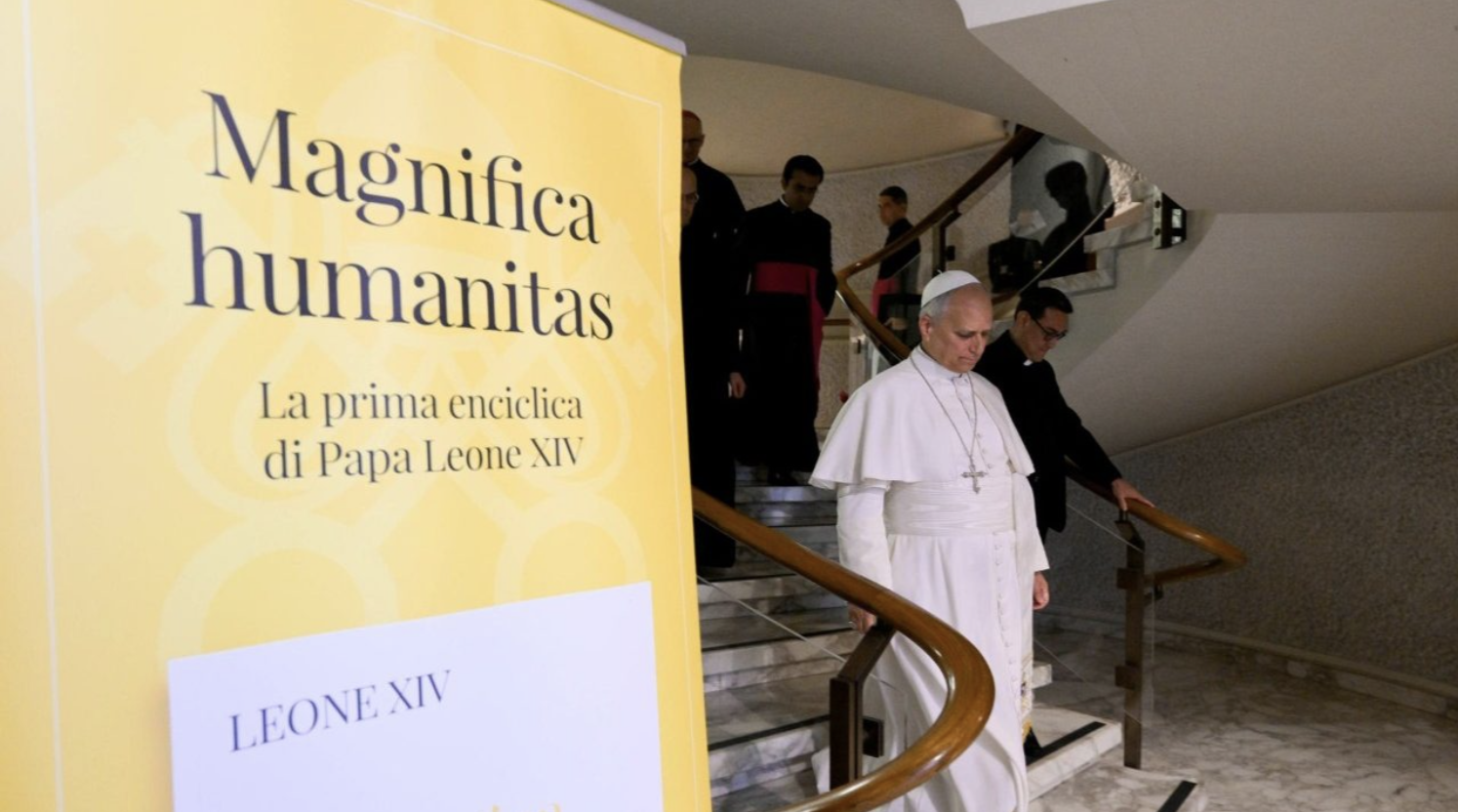
Pope Leo XIV’s first encyclical letter, Magnifica Humanitas, has prompted scholarly and pastoral reflection across the Catholic world. One of the most substantive engagements with the document comes from Rev. Fr. Professor Walter C. Ihejirika, President of SIGNIS Africa and Professor of Development Communication at the University of Port Harcourt, Nigeria, who reads the text not merely as a statement on artificial intelligence, but as a comprehensive reaffirmation of the Church’s social doctrine—and as a direct challenge to the African continent.
In his reflection, Ihejirika situates the encyclical within the broader arc of Catholic social teaching, from Leo XIII’s Rerum Novarum to Francis’s Laudato Si’. His central argument is that Magnifica Humanitas must be read through a wider frame: that of authentic human development, of which the AI question is only one dimension. Through that frame, he identifies three areas of particular urgency for Africa.
The first concerns resource extraction. Ihejirika draws a direct line between the colonial “scramble for Africa” ratified at the Berlin Conference of 1884 and a contemporary equivalent—the race to control rare earth minerals essential to the digital economy. Countries such as the Democratic Republic of Congo, Nigeria, Sudan, and Mali, he argues, find themselves once again at the center of competing external interests, including state actors and transnational corporations. The encyclical’s warning that technological power has acquired an “unprecedented, predominantly private aspect” is read as a moral signal aimed squarely at these dynamics. For Ihejirika, the Pope’s call is unambiguous: African leaders must resist allowing their territories to become extraction zones for a digital revolution that leaves their own communities behind.
The second dimension is human trafficking. Drawing on ILO data indicating that some 49.6 million people are trapped in modern slavery worldwide, Ihejirika notes the disproportionate exposure of African women, girls, and children to forced labor and forced marriage. He credits the Pope with naming this as a contemporary form of slavery and appreciates Leo XIV’s public acknowledgment of the Church’s historical failures during the transatlantic trade. The reflection treats this as more than a gesture: it is framed as a moral baseline from which the Church must now act more decisively.
The third and perhaps most forward-looking argument concerns participatory development. Ihejirika finds in the encyclical’s reading of Nehemiah—the rebuilding of Jerusalem as a collective endeavor—a development model that rejects top-down intervention and embraces shared civic responsibility. The Pope’s appeal, he writes, is for all sectors of society to engage on the “construction site of our time.” For Africa, this translates into a call for citizens, youth, and institutions to take an active role in the digital future rather than passively receive its outcomes.
Ihejirika acknowledges signs of progress. Growing digital participation among young Africans in Egypt, Kenya, Nigeria, and South Africa signals an emerging generation capable of engaging with the global technology landscape on its own terms. The challenge, as he frames it, is ensuring that this participation translates into genuine agency—a seat at the tables where consequential decisions about AI and digital infrastructure are made.
The reflection stands as a reminder that a papal document of this scope reaches well beyond the technological debates that have dominated its reception. Read in the African context, Magnifica Humanitas is, as Ihejirika writes, a wake-up call—one addressed not only to policymakers and institutions but also to the conscience of an entire continent.