


By Maria Agnesa Puscasu, Cannes, May 2026.
I had the privilege of seeing Fjord, Cristian Mungiu’s new film, at the Cannes Film Festival. In the days that followed the premiere, I found myself in countless conversations with festival goers. The moment I said I was from Romania, the next question came instantly: “Have you seen Fjord?” Their admiration — as if I had something to do with the film — made me proud to say yes, and even prouder of the reaction it was generating.
Mungiu returns to Cannes with a story familiar to Romanian audiences: the separation of five children from their Romanian–Norwegian parents after suspicions of physical abuse. Yet, as one of my Norwegian interlocutors observed, this is not a film about Romania or Norway. In the press conference, Mungiu himself framed it as a conflict of values and as a portrait of a society where people have lost the ability to understand those who think differently. For Romanians, who have lived through a year and a half of unprecedented polarisation following the annulled presidential elections, the timing could not be more fitting.
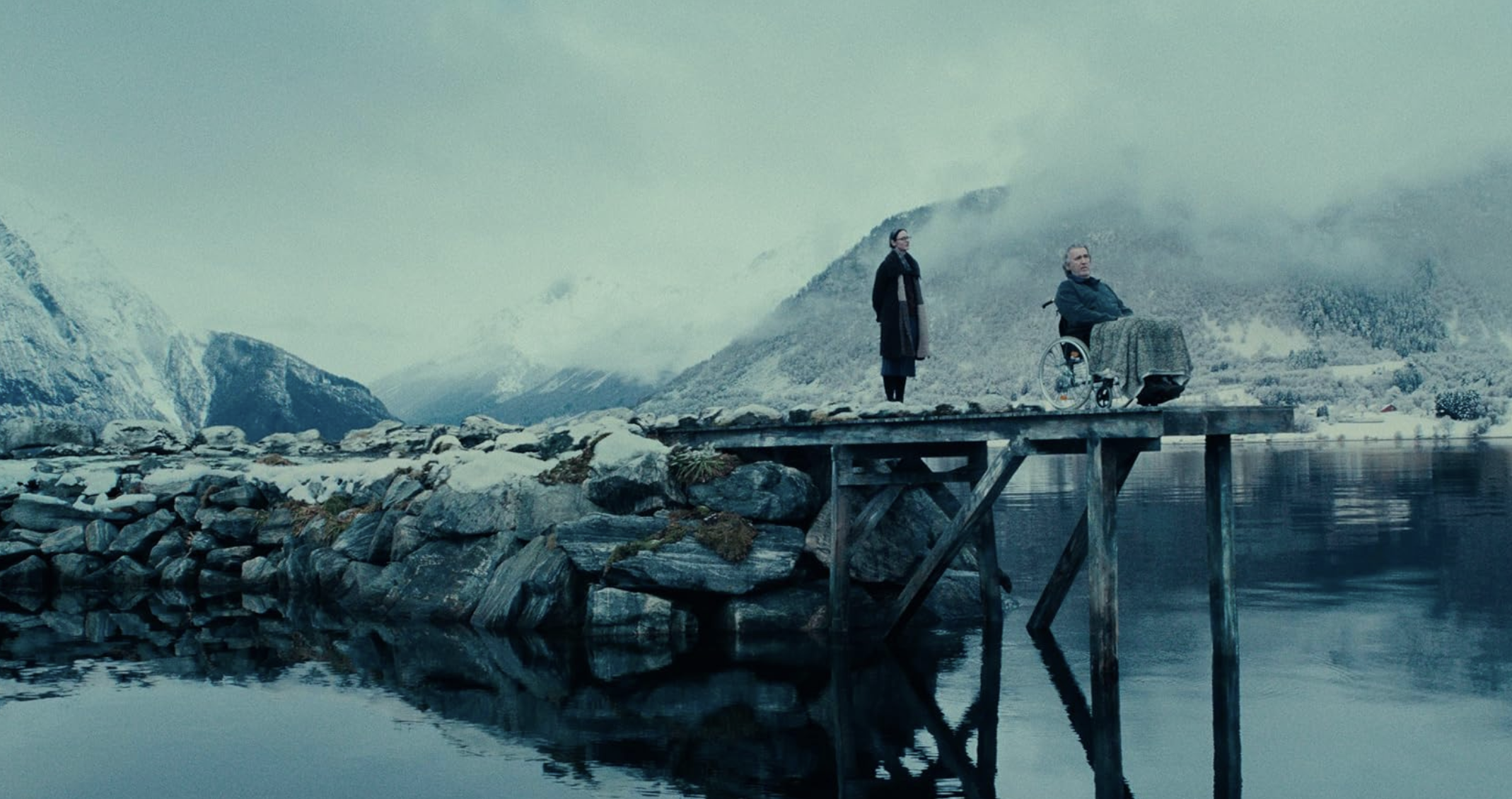
A valley carved by glaciers, filled by the ocean: silent water, a frozen bed, majestic mountains. In such a landscape, every sound carries. And in such a village, a large family who sings religious hymns will be noticed.
The film opens with a breathtaking shot of Norway’s untamed beauty, accompanied by Amazing Grace. “You don’t have to be smart to shoot here, the light is already in place,” Mungiu said, quoting his cinematographer Tudor Panduru. Yet he is — and the film’s cinematography is remarkable.
The film gathers an exquisite cast, with Sebastian Stan and Renate Reinsve in the main roles.
At the press conference, Mungiu recalled meeting Sebastian Stan ten years ago at the Graduation screening in New York. They agreed then to work together someday, and when he started writing the script, Mungiu already had Stan in mind for the role of Mihai. Stan said this film is his way of reconnecting with Romania, which he left young but whose upbringing he still carries.
Unlike Stan, Renate Reinsve noted that she cannot fully relate to Lisbet and spoke about the challenge of interpreting a character without fully understanding her. “I’m not telling anyone what to think.”
Inspired by a real case and enriched with a decade of research into similar stories, Fjordfollows Lisbet, a Norwegian mother; Mihai, her Romanian husband; and their five children, all born and raised in Romania, as they move to a small Norwegian village. He works as an IT engineer for the local authorities; she is a nurse in a care home. Their older children, Elia and Emanuel, befriend Noora, the daughter of the school principal and their neighbour. The family is deeply devout, part of the Pentecostal church.
After a domestic incident in the Gheorghiu household, a teacher notices bruises on Elia’s face and neck. Questioned by their teachers, the children admit that their parents sometimes apply physical coercion. Summoned by the police, the father acknowledges he has spanked them on a few occasions when they misbehaved.
Child protection services intervene swiftly. The mother, home with the baby and unaware of the interrogation her husband and children are undergoing, is informed — with bureaucratic calm, tea in hand, the Norwegian flag fluttering in the background — that her children are being taken into child protection custody during the investigation.
What follows is a collision of cultures, values, and worldviews.
In the weeks before the separation, the school safeguarding lead is instantly triggered by the Gheorghiu children expressing their beliefs about God, sin, or samesex couples. Even playing Amazing Grace on the school piano — without lyrics — is deemed unacceptable.
Meanwhile, Noora casually cuts her wrist or gets into a fight with a colleague during physical education class. Noora’s household never raises an eyebrow — in stark contrast with the Gheorghiu family, who inflame the authorities simply because their children have limited access to electronic devices and because their church forbids dancing. “The children are not allowed to watch YouTube!” the social worker exclaims in shock.
Are either of the parents mistaken? Are they doing what is right for their children? They are certainly trying.
“The private situation inside a family becomes political because you are raising a future citizen,” notes Renate Reinsve.
Mungiu insisted that films should be ambiguous: “I don’t believe in films that confirm what you already know. Cinema should make you think and see whether your thoughts are truly your own.” He described Fjord as an investigation into the limits of intimacy and freedom. What happens when your values do not align with the society you choose to live in? “You are powerless. You are not at home.”
During a school celebration of cultures, an avalanche hits. Even though it is visible from afar, no one seems disturbed by it, and when the principal finally invites everyone calmly inside, they all go as if for a drill. The film itself often stands still, like the people facing the snow behind the avalancheproof walls of the school. The characters carry their avalanches inside, not showing much on the outside. The discreet performances are one of the delights of the film.
This stillness is disturbed only by the loud protesters outside the tribunal, demanding that the children be returned to their family.
“The religious mob is as violent as any other mob,” the prosecution lawyer acknowledges.
The avalanches, the Romanian authorities intervening to support the Gheorghiu family, Noora walking on the ferry platform as if walking on water, Mihai’s videos for social media — all are small details that enrich the bigger picture.
The film presents a series of beautifully crafted opposing views and incompatibilities. It doesn’t offer answers. You are left to make your own judgement — or perhaps simply agree to disagree.
“Am I not allowed to believe that?” as Mihai would say.