


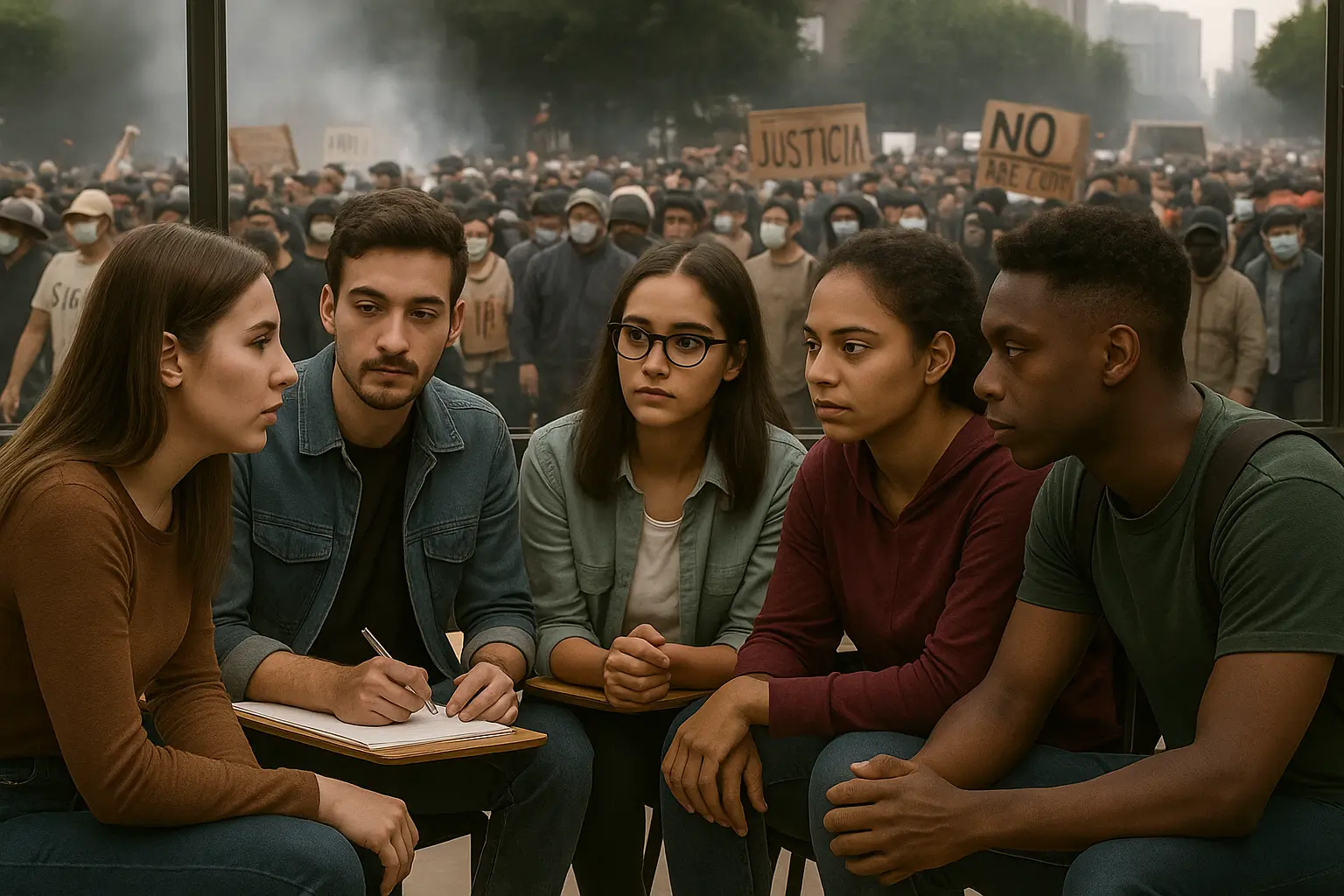
Santiago, Chile (September 2025) – SIGNIS Latin America and the Caribbean, in partnership with the Latin American Center for Education and Communication (CELAEC) and universities, has launched the “Young Innovators for Fraternity” program, which is mobilizing 103 young individuals across Ecuador, Colombia, Chile, and Argentina. This initiative combines training, project design, and an implementation phase. Only 12 proposals will receive technical support and nearly US$2,000 each for on-the-ground implementation between March and October of the following year.
The program coordinator, Alejandro Caro, Vice President of SIGNIS ALC, explains the approach with a guiding principle: “The only way to transform society is when I recognize the other as my legitimate other; on our own, we will never achieve it.” This concept, referred to as transformative fraternity, translates into practical guidelines for the participants: teamwork, effective disagreement management, active listening, and cooperation with local stakeholders.
The program timeline includes training sessions in September, October, and November 2025—with the possibility of in-person gatherings when conditions allow. One such gathering is already being planned in Chile. The training will focus on problem diagnosis, creativity, and innovation, with a measurable objective: for teams to progress from idea to prototype, preparing logs and materials for fieldwork.
SIGNIS ALC estimates that between 40 and 50 projects will be submitted before the final selection occurs. A committee will choose 12 based on criteria such as innovation, creativity, alignment with the program’s goals, and sustainability. Those not selected will still be encouraged to participate in related initiatives to enhance execution and document lessons learned. Emphasizing local partnerships—including parishes, universities, neighborhood organizations, and authorities—is central to ensuring that the services or networks created remain sustainable after the pilot concludes.
The distribution among the countries shows both variety and diversity. Colombia and Ecuador, with an Andean focus, have a significant share of participants, while Chile and Argentina, more urban in profile, have somewhat fewer. The cohort consists of university students, working professionals, and individuals with no prior experience in social work—an opportunity seen by the team to build civic capacities from the ground up. “There are participants with different backgrounds; what matters is that everyone recognizes they have something to contribute,” Caro explains.
The financial support serves as seed funding: each of the 12 selected teams will receive approximately US$2,000 but will be required to supplement this with public and private fundraising in their respective communities. Caro emphasizes that this funding buys time and allows for testing; the legitimacy of the project will ultimately depend on the results and the enduring network created. The operational goal, according to Caro, is to reach October with executed pilots and basic evidence of impact, including reach, observable changes, costs, and partnerships, to determine whether to scale or replicate them.
What makes this project innovative is its method and commitments: a regional pilot that transitions from training to action, with strict selection criteria, limited resources, and an emphasis on accountability. If successful, it will yield more than just minutes or videos; it will create services that continue to operate, strengthen neighborhood networks, and empower young people with real collaborative experience. In an ecosystem filled with good intentions, the program presents a practical challenge: to transform society collectively, at a local level, with a citizen-centered approach, and with a defined timeline for delivery.