


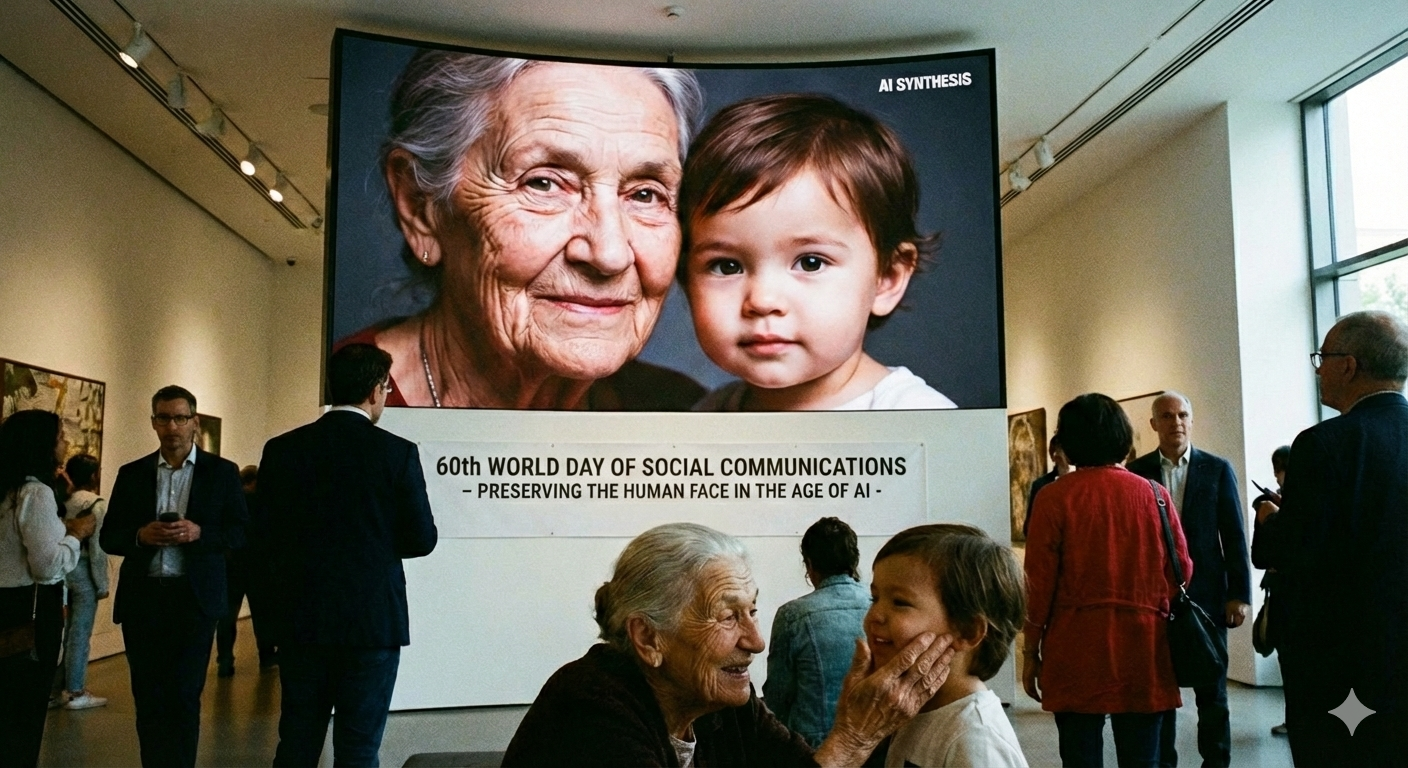
- Pope León XIV warns journalists and media professionals that artificial intelligence threatens the essence of human communication.
As algorithms increasingly dictate what billions see and think, the Vatican has issued a stark warning: the race toward artificial intelligence risks erasing what makes us uniquely human – our faces and our voices.
Pope León XIV’s message for the 60th World Day of Social Communications, released January 24, 2026, challenges journalists, communicators, and media professionals to confront a fundamental question. At stake is not simply whether new technologies work, but whether they will reshape human identity itself.
Titled “Preserving human voices and faces,” the document frames this as an anthropological crisis, not merely a technical one. The face and voice, the Pope argues, are not biological accidents but unique and distinctive traits that express personal identity and enable authentic encounter. When communication platforms treat people as data points rather than persons, something essential is lost.
The message identifies several threats that working journalists will recognize immediately. Social media algorithms reward outrage and emotional reaction while punishing careful analysis. The result – information bubbles that intensify polarization and corrode critical thinking.
More insidious is the subtle outsourcing of thought itself. As users turn to AI chatbots for instant answers and ready-made analysis, the Pope warns of human cognitive and emotional capacities atrophy. Convenience comes at the cost of the gradual silencing of genuine human voices.
AI may assist communication tasks, the document states, but avoiding the effort of thinking for ourselves weakens our ability to reason, question, and create.
Perhaps the most urgent concern for journalism is simulation. AI-generated influencers, manipulated voices, and deepfake videos now blur the line between authentic human presence and manufactured fiction. The technology doesn’t just spread misinformation, but also erodes the very foundation of trust.
The Pope calls out AI “hallucinations” and weak source verification as accelerants of public distrust. When anyone can fabricate a convincing video of a public figure saying anything, how can audiences know what’s real?
For vulnerable users, the risks multiply. The Pope’s message notes that seemingly affectionate chatbots can invade emotional and private spheres, creating parasocial relationships with entities that merely simulate care.
Meanwhile, human creative industries are being dismantled. As AI systems churn out texts, music, and videos at an industrial scale, art and journalism risk becoming mere training material for machines. The dignity of human authorship and the economic models that sustain it hang in the balance.
Crucially, the Vatican does not call for halting innovation. Instead, the Pope proposes what he terms a possible alliance with AI, built on three foundations: responsibility, cooperation, and education.
Responsibility demands transparency from developers, ethical business models from platforms, and regulation protecting human dignity. Media organizations must resist the temptation to sacrifice truth for engagement and clearly label AI-generated content.
Cooperation acknowledges that no single sector can govern AI alone. Journalists, educators, technologists, regulators, and civil society must build safeguards together.
Education is presented as the most urgent task of equipping people with media, information and AI literacy. Citizens must learn to evaluate sources, understand algorithmic influence, protect privacy, and resist treating machines as human.
The message closes with a challenge. Technological progress, the Pope insists, must serve the deepest truth of humanity through genuine communication grounded in dignity, freedom, and encounter.
For journalists navigating an industry transformed by AI, the implication is clear. Defending truth today means defending the human presence behind it. It should not replace the faces and voices of such presence.
In an age when synthetic content proliferates and attention spans fragment, the Vatican’s message offers both a warning and an invitation to remember what communication is for and who it is meant to serve.