


This subtitled German, Austrian and French film tells the story of a French family and their two children after an unspecified event disrupts Society forcing them to flee for their lives. It is released unusually in Australia at this time to honour the memory of his films.
TIME OF THE WOLF. Starring Isabelle Huppert, Lucas Biscombe, Anais Demoustier, Lucas and Daniel Duval. Directed by Michael Haneke. Rated MA15+. Restricted (strong violence, strong themes). 113 min. It is part of a retrospective screening of films, that Haneke has made.
Review By Peter W Sheehan, Jesuit Media Australia
This film is a post-apocalyptic drama set in France at an undisclosed time, and is directed by Michael Haneke, an accomplished film Director living today. The movie takes its title from an ancient Norse poem: “The time of the wolf”- a time which occurs at night when people die, and nightmares are at their most powerful. The film follows George (Daniel Duval), his wife, Anne (Isabelle Huppert), and their two children, 14 year old Eva (Anais Demoustier), and ten year old Ben (Lucas Biscombe). When George is killed shortly after arriving at their holiday home with his family, the rest of the family flees to find safety, and the remaining family members wander around devastated. What was once their house was occupied by an armed man; surrounding villages have been burnt to the ground; and survivors are unable, or unwilling, to help. Tensions speedily arise about access to resources that might have assisted. Ben runs away traumatised; and George’s killer later joins the group; a train arrives carrying survivors of terrible happenings; and we have no idea about where the train was heading.
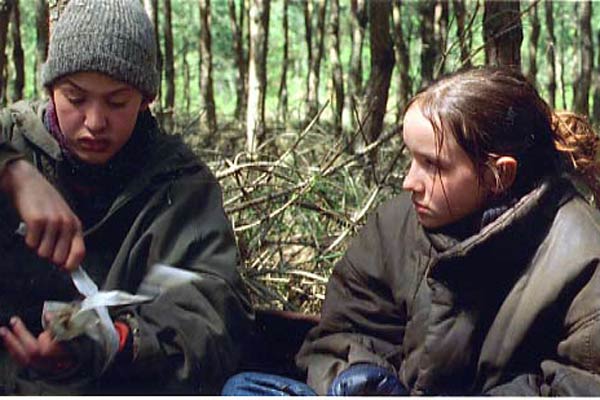
This is a disturbing movie that unrelentingly portrays human despair. Complete social breakdown has occurred and shows no signs of recovering. The film depicts a Society that has nothing to say to justify its survival, and we are presented with a Society that dramatically is not worth saving. We never learn what happened before the train arrives. There is virtually no discussion by anyone in the film about what occurred, but we do know that Society has been brutalised. Haneke has created a tension that permeates the entire movie, and his tension is reinforced by excellent camera-work and the film has a haunting musical score. This is a stark, unrelenting film about a world descending into chaos. Humanity manages to arise from time to time, but can’t exist because there are no restraining rules, morals, or regulations for ethical survival. We are faced with a lawless Society where uncertainty and disaster are tearing the world apart.
The film is brilliantly directed by Haneke in a stunning emotional-piece. Characteristically, he uses graphic imagery as a microcosm of Society in darkly atmospheric and revelatory ways, which linger stirringly.
Reviewed by Peter Sheehan, an Associate of Jesuit Media