


By Maria Agnesa Puscasu
Part II
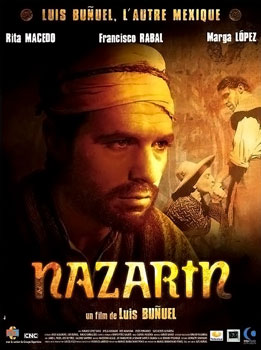
Nazarin (1959)
Director: Luis Buñuel
Screenplay: Luis Buñuel, Julio Alejandro
Cinematography: Gabriel Figueroa
`In several villages of Aragón there is a custom probably unique in the world: the drums of Good Friday. The drums are beaten in Alcañiz and Hijár as well. But nowhere with the mysterious and irresistible force of Calanda. They commemorate the darkness that covered the earth at the moment of Christ’s death, as well as the earthquakes, the falling rocks, and the church veil torn from top to bottom. I have used these deep, unforgettable beats in several films, but especially in L’Âge d’Or and Nazarin.`
Nazarin, whose screenplay is adapted from the novel by Benito Pérez Galdós, was filmed in 1958 in Mexico. Buñuel recalls how Gabriel Figueroa had prepared a frame that was aesthetically perfect, with the Popocatepetl volcano in the background and white clouds around it. To Figueroa’s despair, Buñuel simply turned the camera toward a banal landscape, which seemed much more appropriate to him, as he says, because “I have never liked prefabricated cinematic beauty, which often makes you forget what the film wants to say and which personally does not move me at all.”
This statement is confirmed throughout Buñuel’s work, but it can be understood in particular as a summary of the film whose subject is a priest with a faith and devotion entirely unembellished — a film for which Buñuel nearly received the Catholic Office Prize, and which many (unjustly) viewed as an attempt at rehabilitation on the part of the author.
Nazarin can be seen as a parallel to the life, passion, and death of Jesus Christ.
The film follows the story of Father Nazario and the devotion with which he lives the Gospel.
Nazarin is introduced in the film through his voice, which we hear from offscreen while we see the courtyard of the hostel where he lives, full of merchants and locals.
In the first ten minutes we receive information about his social situation (his relationship with the neighbors, with the women on the street, with the landlady, with the poor), his material situation (his few and only possessions are often stolen, he has no food and no money at all), and his spiritual situation (he is a priest and has chosen to live in poverty, like his parishioners).
During this time we also learn about him as a person. He is gentle and humble (he does not respond to the women who come to insult him), he is moderate and frugal (he asks for no more than the bare minimum), almost ascetic.
In this introduction we encounter the first temptation — the temptation to rebel — brought by the two men who question him and confront him with the possibility of asking his superiors for more.
Buñuel constructs Nazarin’s humility through gestures (Nazarin accepts the officials’ money), through relationships established in dialogue (Nazarin stops the incisive speech of the two men), and through nonreaction (toward the women who come to insult him).
“The hero’s conception of Christianity leads him to oppose the Church, society, and the police. Nazarin follows the great tradition of Spain’s madmen initiated by Cervantes. His madness consists in taking great ideas and great words seriously and trying to live according to them.”
After being expelled from his town and having his priestly license revoked, Nazarin sets out on the road like a pilgrim to Santiago de Compostela. Beaten, threatened, and repressed by the communities he passes through, the priest arrives in a village where he meets Beatriz who, like the Roman centurion, calls him to her sister’s house to heal her daughter.
The women in the village scream, beat their chests with their fists, drive out demons, touch Nazarin as if he were a sacred object, dab him with healing leaves, roll on the ground, implore — all of this under Nazarin’s gaze as he stands motionless, watching the grotesque spectacle unfolding before his eyes and seemingly begging forgiveness for them, for “they know not what they do.”
“Superstition is the deviation of religious feeling and of the practices it imposes. It can also present itself under the guise of worship offered to the true God, for example when a somewhat magical importance is attributed to certain practices that are otherwise legitimate or necessary. To tie efficacy solely to the materiality of prayers or sacramental signs, apart from the interior dispositions they require, means falling into superstition.”
Buñuel’s caricatural vision of “devout” women, however, does not extend to Nazarin himself. Until the end, the episodes he goes through (the garden of olives — on the night before his arrest; the arrest and the violence of Peter — Andara, who jumps to defend him when the police arrive; the trial; the mockery of the thief on the right and the intervention of the one on the left — in prison) do nothing but make you wonder, Buñuel says, what will happen next, and look at this character to whom so much has happened.
Nazarin is true to himself and to his faith in every aspect of his life, against all odds, until the end.