


By Maria Agnesa Puscasu
Part I
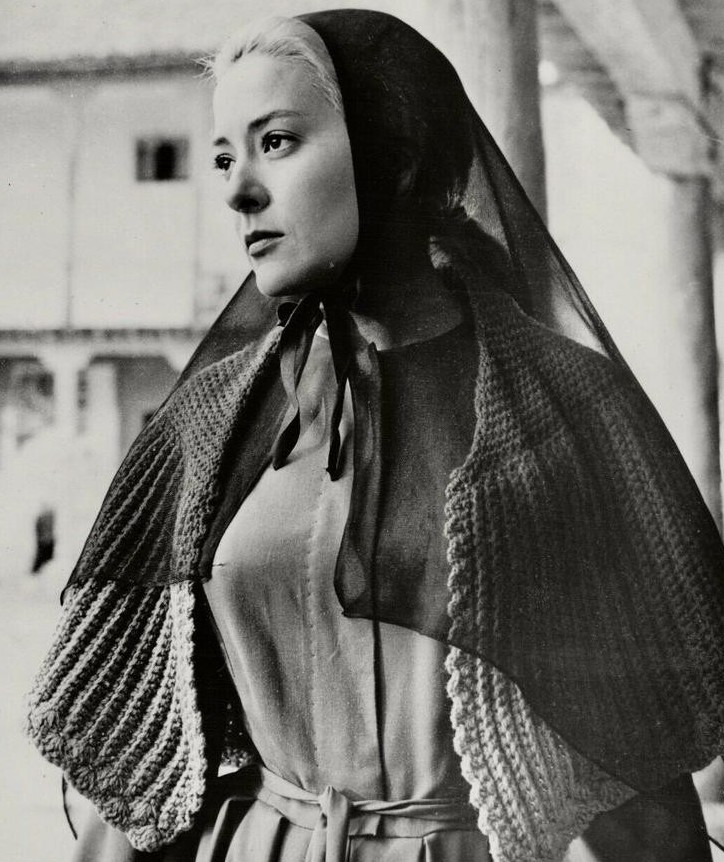
Viridiana (1961)
Director: Luis Buñuel
Screenplay: Luis Buñuel, Julio Alejandro
Cinematography: José F. Aguayo
“Centered on Buñuel’s trinity of eroticism–religion–death, Viridiana is a parable of the birth of life, of the ascent toward the human, of the negation of all taboos and Christian precepts that suffocate personality.”
Viridiana is a saint commemorated by Christians, both Orthodox and Catholic, on February 1st. She is a virgin who decides to dedicate her life to God. Her uncle leases his estate to her, including barns filled to the brim. Viridiana gives everything stored in her uncle’s granaries to the poor. When he finds out, he becomes terribly angry, and the saint asks him to wait another 24 hours. During this time she remains in prayer. When the uncle returns, the barns are full again. Saint Viridiana lives her final days in northern Italy, in a small cell where she spends time in prayer, isolated from the world, receiving food and even attending Mass through a small window.
Luis Buñuel knew the story of this saint, and all he probably had to do was ask himself what would have happened if she had not remained faithful to God.
To this story he added an older erotic dream in which he enjoyed the Queen of Spain thanks to a narcotic. This, he says, led him to the story of a young woman drugged by an older man. The woman had to be pure, so he made her a novice.
“His resentments toward the Catholic Church triggered the image of the nun turned mistress of a macho landowner, who would drive the piety of the convent out of her head. The nun would probably open the house to the poor.”
This is Viridiana, Buñuel’s work in which a group of beggars reenact, sacrilegiously, Leonardo da Vinci’s Last Supper.
The producer — the husband of the beautiful Silvia Pinal, for whose love he began working with Buñuel — told him the film would be shot in Spain. This created problems for Buñuel, who faced vehement protests from Mexicans accusing him of betrayal.
Nevertheless, the film was shot in Spain, and Franco’s regime had so much confidence in Buñuel that they sent the film to Cannes without watching it. The film won the Palme d’Or, and only afterward did Franco and the Catholic Church learn that they were targeted by the film.
Although he reacted immediately, Franco did so under external pressure, without having seen the film. The National Director of Cinematography in Spain was forced into retirement, and the film was banned, all copies burned — as Silvia Pinal recalls, she herself saved one copy, carrying it in her hand all the way to Mexico. The Spaniards did the same, burying a print in Domingo Gonzalez’s yard.
The ban remained in place for a long time in Spain, while in Italy Buñuel was even sentenced to one year in prison should he cross the border. The film was shown in basements, in hidden rooms; the police intervened whenever they discovered a screening, and it took a long time before the film could circulate, because being a Spanish production and banned there, it could not be distributed. After many years and lengthy trials, it was finally screened as a Mexican film.
The Spanish co-producers say that, after some time, Franco saw the film and did not understand why there was so much agitation about it, but, Buñuel comments, “truth be told, after all he had seen, the film must have seemed downright innocent to him.”
Although the general opinion about Buñuel is that he is determined to attack the Church, Christianity, Catholicism, the quotation below contradicts these views:
“Buñuel, wondering whether the depiction of scandal based on faith can be expressed in religious terms, always said that the film is, in essence, devout, because in every scene you feel the oppressive presence of sin. The old man cannot rape Viridiana because of this. Gabriel Figueroa also believes that Buñuel is merely irreverent, not anti-Catholic. The irony is that although his films are labeled anti-religious and anti-Catholic, Buñuel is actually preparing for the afterlife, always trying to draw closer to God. He is one of the most religious men.”
Viridiana brings to the forefront many of Buñuel’s obsessions: foot fetishism (Fernando Rey puts on his deceased wife’s shoes; Viridiana’s feet are often filmed uncovered, as an intrusion into her virginal intimacy), sexual obsessions (the uncle who wants to possess his niece), the attraction to death (the uncle dresses his niece — drugged — in the dress in which his wife died), and, not least, sin and temptation.
Viridiana is sent into the world, away from the safety of the convent she had probably not left since childhood (we can easily assume that her entire education was given by the nuns), against her will, at the request of the Mother Superior, moved by the uncle’s insistence.
Viridiana, eager to do good and to submit to God’s will, lacks the practice of living in the world, so that “the bad example given by others, enslavement to the passions, the claim of a misunderstood autonomy of conscience, the rejection of the Church’s authority (…) can be at the origin of deviations in moral judgment.”
Tested by her uncle’s desire to marry her, Viridiana’s vigilance and longing for solitude weaken — things we see even as she leaves the estate: hesitating, looking back, boarding the bus last. Her uncle’s suicide pushes her to make, for the first time, a decision: not to return to the convent.
`Every Friday morning, a dozen elderly men and women would slowly sit down, leaning against the church wall in front of our house. They were los pobres de solemnidad, the poorest of the poor. One of our servants would come out and give each of them a piece of bread, which they kissed respectfully, and a ten-cent coin — a generous alms compared to the “centima de barba,” the single cent usually given by the other wealthy people of the village.`
With this image from Buñuel’s childhood begins the second part of the film. After her uncle’s death, Viridiana begins her charitable work, continuing, as she wished to believe, the Lord’s mission.
Human misery — a theme Buñuel revisits (from Las Hurdes, Los Olvidados, The Exterminating Angel) — is present in the sick, the prostitutes, the criminals whom Viridiana shelters. This plague cannot be redeemed in Luis Buñuel’s work, and he is often accused of not offering solutions, although his role is neither that of educator nor legislator.
Prudence, writes Saint Thomas Aquinas after Aristotle, is “the right rule of action.” Perhaps this is what Viridiana lacks in her relationship with the poor.
She continues her “vocation” with the dedication with which she cares for the poor, educating them in the spirit of work and prayer. The sequence of the Angelus, edited in parallel with physical labor, can be seen as a parallel between the usefulness of prayer — denied by Buñuel — and the usefulness of real work, with the sweat of one’s brow, performed by “serious” people. This duel also takes place within Viridiana herself and may be the theme of the film.
Her confusion grows with the arrival of Jorge, the son of the deceased, toward whom her passion will soon be directed. If at first she receives him as a brother, she later rejects him as a suitor.
Viridiana’s arrogance is restrained and mocked, subdued by Jorge. He does not spare her in any way, as her uncle and Ramona, the servant, tried to do; he “slaps her hand” at every attempt she makes to lead the conversation in any direction.
Viridiana’s strength in front of him is supported only by the refuge she finds in her work with the poor — work that will not last much longer, as they reveal their full misery and degradation in an iconic sequence: the sacrilegious reenactment of Leonardo da Vinci’s Last Supper.
“By depicting each character’s confrontation with reality and their inadequacy in relation to that reality, Buñuel portrays the failure of the old Spain’s dogmatism, reflecting a moral stance toward a society to which he belongs, whether he wants to or not, and which plays a decisive role in his life.”
The censorship of the time in Spain was notorious for hunting down any trifle. The first ending Buñuel had in mind showed Viridiana knocking at her cousin’s door. The door opened, she entered, the door closed.
The censors rejected this epilogue, so Buñuel invented another ending, much more serious than the first, as it suggested a ménage à trois. Viridiana sits down to play cards with her cousin and the other woman, who is his lover. The cousin tells her: “I knew you’d end up playing tute with us.”
“Viridiana caused a scandal of great proportions in Spain — comparable to the one provoked by L’Âge d’Or — so the Republicans settled in Mexico forgave me. Because of a hostile article in L’Osservatore Romano, the film, which had recently won the Palme d’Or at Cannes as a Spanish production, was immediately banned in Spain by the Minister of Tourism and Information, and the Director of Cinematography was forced into retirement because he had gone on stage to receive the award. The incident caused such a stir that Franco himself wanted to see the film.”